Friday, January 4, 2013

Porkfish


Common Name: Porkfish
Scientific Name: Anisotremus virginicus

Family: Haemulidae - Grunts
Class: Actinopterrygii - ray-finnned fishes

Conservation status: Not yet assessed
Sighting: Common on rocky reef areas.


Yesterday we went to Dania beach (John U. Lloyd beach park), in fort Lauderdale, and found a great snorkeling area. The tide was low, the water transparent as if it was not there, and the cloudless sun beamed through the quiet waves creating a magic diving atmosphere.

The interesting area starts around 200 ft - 60 mt from the shore. Although a bit deep for our poor snorkeling abilities, (10 feet -3 meters), the algae bottom starts to become a reef, with large coral formations, and plenty of colorful fishes.

We captured many interesting creatures that we are now identifying, so we can post them, but as a primer, here is a short video of this graceful school of porkfish. The only thing not to like is the awful name for these beautiful grunt fishes.
We could not take a good close up picture, they swim so fast!, so a frame from the video will have to do. 


We had seen porkfish before, in Virginia keys. It is very easy to identify, with its two distinctive black strikes in the front, but we had not seen them on groups, always as one or two specimens swimming among other species (most in this series of videos are yellow fins).


Watch this space for better pictures and more videos of porkfish.


Wednesday, December 26, 2012

Halimeda


Common Name: Unknown - Cactus Alga? Coin Green?
Scientific Name: Genus Halimeda - Halimeda discoidea?

FamilyHalimedaceae - Halimeda is the only genus
Class: Bryopsidophyceae - macroscopic green alga

Conservation status: Not yet assessed
Sighting: Ocasional


Identifying this species is very difficult for the amateur, as seems common with alga and seaweed. We think this beautiful alga is part of the genus Halimeda, but we can not narrow down to which species it really belongs. Lacking a good alga identification site, we have found pictures of Halimeda discoidea looking very similar, but then, some other H. discoidea pictures looked completely different, showing branches or segments of discs, which do not seem apparent in our pictures. It may well be some of the pictures are misidentified themselves, making the whole search even more challenging. 

In any case, Halimeda, described as a "green macroalgae, with a body (thallus) composed of calcified green segments", and the pictures of some of its species (it has more than 40 species listed, we didn't found examples of all), seem close enough to give us confidence we have the right genus.


Of the various common names we have found for species of this genus, green coin seem to be the most appropriate to this particular specimen. At least that is how we would describe it, they are the size of a US dollar quarter, but thicker, with a characteristic bright green rim. They do look like some Crassulacean plants (cactus without spines, if you want), therefore the "cactus alga" name, which also seem suited to this particular example.


FInally, in this -poor- video you can take a look how the colonies are interspersed within the turtle grass. You can also see a starfish featured in Cushion Starfish post, and the location of the area near Bill Baggs Cape lighthouse where you can find this species.


Look for an update on this page with better video, and hopefully full identification of the species. We will try to carefully analyze the stem structure, to see if it matches the descriptions.

Sunday, December 23, 2012

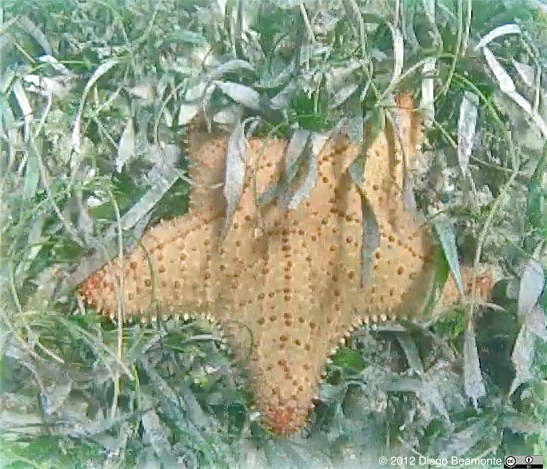
Cushion Starfish


Common Name: Cushion sea star
Scientific Name: Oreaster reticulatus

FamilyOreasteridae - Heavily calcified, large bodies
Class: Asteroidea - True starfishes or sea stars

Conservation status: Not assessed
Sighting: Ocasional, in deeper shore waters.


You can find this beautiful large equinoderms in the edge of the swimming area in Bill Baggs Cape Florida State Park, near the lighthouse

Colors range from bright red to orange to pale yellow. They are large, about the size of one extended hand.
Taking this picture (actually a frame from the short video below) cost me a bad cramp on my left leg.


The tide was high, and the strong current forced me to keep swimming at full speed just to stay still. While trying to do a final push to get a close up picture, my left leg got cramped, really bad. Seconds after I was drifting at about 4 knots away, and I had to star swimming to the shore with only one leg. If you can picture limping while swimming, that was me. It was painful  but the fear of being drifted past the lighthouse point, into the open waters of Key Biscayne, was even worse. Doing a last effort, I reached with my hand to the sharp edges of the last rock in the point, and held there, hanging just from my hand while the rock cut my fingers, while the current pushed my body like a kite. After a couple of minutes, I could recover my breath, and finally made it safe to the shore, and my wife helped recover the cramped leg with her expert massage. A lesson about the strong tides in Bill Baggs Cape I wont forget easily!

I'll seek more of this beautiful animals, and will eventually replace this picture with a better one. There are plenty, but as they are in 5-10 feet (2-3 m) waters, light and water turbulence conditions are a challenge to get a good video or picture.

Update on 12/25 - I got a couple more pictures of beautiful cushion sea stars, as always, from the area in front of the Bill Bags lighthouse. The first one, more red in color, was beautiful, with heavily calcified spines on top.


The second one, yellowish, was huge, about a hand an a half (40 cm - 16 in) in size.


In this second one you can clearly see a paler circular structure, a bit off center - see enhanced picture below, and it is also visible in the red cushion star detail picture, above. This is the madreporite, basically a intake water control valve. You can find an excellent description, with schematic on how it works, and many more interesting details, in "The Echinoblog".