Showing posts with label orange. Show all posts

Saturday, January 5, 2013

Flamingo Tongue Snail


Common Name: Flamingo Tongue Snail
Scientific Name: Cyphoma gibbosum

Family: Ovulidae - false cowries, predatory and parasitic sea snails
Class: Gastropoda - Snails and slugs

Conservation status: Not yet assessed
Sighting: First time sight, apparently it is common in reefs


While snorkeling in Dania Beach, taking pictures of different specimens of this branched sponge, very common in the area (soon to be featured in this blog, once we finish its identification), we noticed something unusual. If you watch the picture below, you can see three orange formations. Two of them , the two on the left and center, were just algae build ups. But the third one, had a brighter orange color, and more defined shape, so we too a closer look. 


In this enlarged picture of the creature, you can see better details. It does look like a slug, with beautiful bright pinkinsh-orange color, and yellow spots circled in brown. The actual size is about an inch (the diameter of the sponge branches is about thumb size).


We have spent some time searching sea slugs, trying to identify the species, unsuccessfully. Until we noticed that unusual protuberance in the middle of the body. This is not a slug, it is a snail!. A very peculiar one, as the bright color is not the shell, it is actually the mantle, that protrudes from the body and encloses the shell, which is plain white. The protuberance in the middle shows where the actual shell lays.


Finally, here is a video of the whole think, showing the sponge from the water level, and a close up of the sponge focused on the snail, as the sponge gently moves with the waves. The snail actually eats the sponge, which recovers growing more polyps.  


Definitively, a very exciting sight. We are looking forward seeing more specimens of this snail.

Sunday, December 23, 2012

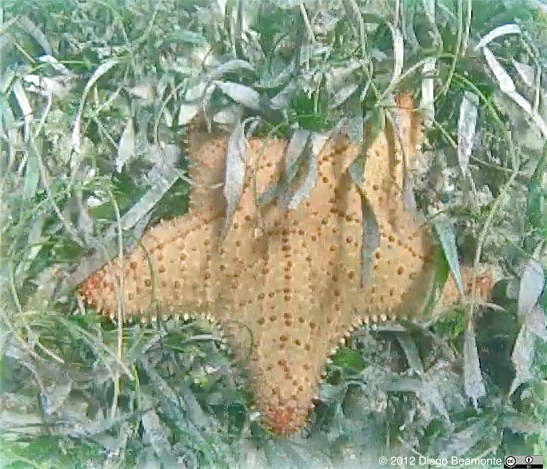
Cushion Starfish


Common Name: Cushion sea star
Scientific Name: Oreaster reticulatus

FamilyOreasteridae - Heavily calcified, large bodies
Class: Asteroidea - True starfishes or sea stars

Conservation status: Not assessed
Sighting: Ocasional, in deeper shore waters.


You can find this beautiful large equinoderms in the edge of the swimming area in Bill Baggs Cape Florida State Park, near the lighthouse

Colors range from bright red to orange to pale yellow. They are large, about the size of one extended hand.
Taking this picture (actually a frame from the short video below) cost me a bad cramp on my left leg.


The tide was high, and the strong current forced me to keep swimming at full speed just to stay still. While trying to do a final push to get a close up picture, my left leg got cramped, really bad. Seconds after I was drifting at about 4 knots away, and I had to star swimming to the shore with only one leg. If you can picture limping while swimming, that was me. It was painful  but the fear of being drifted past the lighthouse point, into the open waters of Key Biscayne, was even worse. Doing a last effort, I reached with my hand to the sharp edges of the last rock in the point, and held there, hanging just from my hand while the rock cut my fingers, while the current pushed my body like a kite. After a couple of minutes, I could recover my breath, and finally made it safe to the shore, and my wife helped recover the cramped leg with her expert massage. A lesson about the strong tides in Bill Baggs Cape I wont forget easily!

I'll seek more of this beautiful animals, and will eventually replace this picture with a better one. There are plenty, but as they are in 5-10 feet (2-3 m) waters, light and water turbulence conditions are a challenge to get a good video or picture.

Update on 12/25 - I got a couple more pictures of beautiful cushion sea stars, as always, from the area in front of the Bill Bags lighthouse. The first one, more red in color, was beautiful, with heavily calcified spines on top.


The second one, yellowish, was huge, about a hand an a half (40 cm - 16 in) in size.


In this second one you can clearly see a paler circular structure, a bit off center - see enhanced picture below, and it is also visible in the red cushion star detail picture, above. This is the madreporite, basically a intake water control valve. You can find an excellent description, with schematic on how it works, and many more interesting details, in "The Echinoblog".