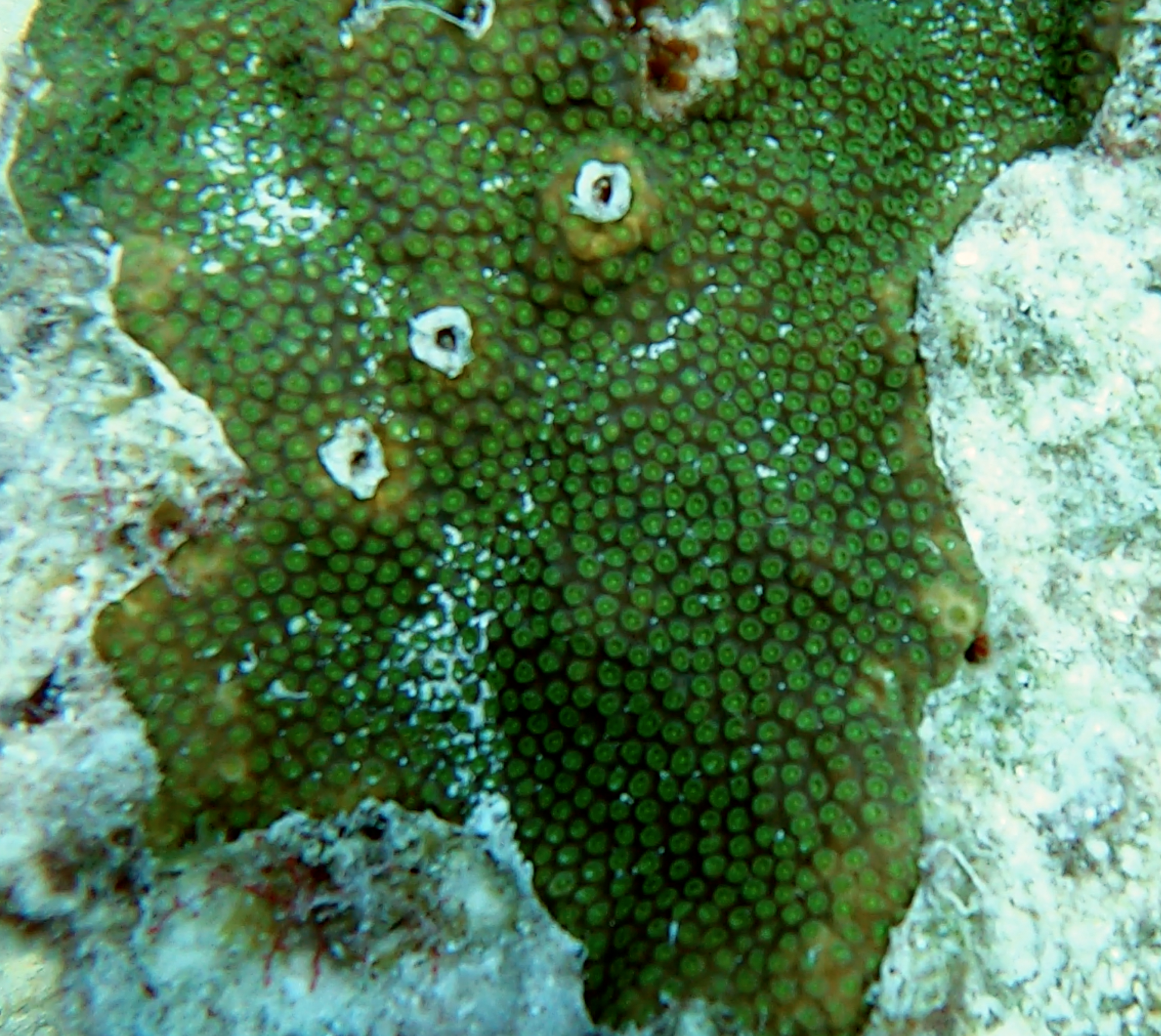
This beautiful stony coral seems to be a green type of Star Coral, genus Orbicella, most likely Orbicella annularis (Boulder star coral). Although stony corals are the most common reef builders, and there are plenty of brown colored ones on Rainbow reef, this was the only coral of this great deep green hue we saw during our dive.
A video of the whole formation (apologies for the shaky and shadowy image)
Orbicella corals typically grow in boulders and domes (therefore the common name of Boulder or Moutain star corals), but occasionally you find them in sheets, as in our case: with some small protuberances, but mainly laying flat around the surface of the rocks beneath it.
It seems it is difficult to single out one species from the genus. Until recently, they were considered a single species (Montastraea), and you can still find it named as such in many places. In 1992, with molecular characterization techniques, it was found to be three separate species, and the genus reassigned to Orbicella
The Common Sea Fan (Gorgonia ventalina) stands majestic waving at the currents. This coral is easy to identify due to its shape. There are other close varieties in the family, but aparently they are found less frequently in the Miami reefs. Also found it named Purple Sea fan
This short video shows the waving movement
Sunday, January 10, 2021
Purple Sponge
This beautiful sponge shines in the reef due to its purple color and distinct shape.
I believe it belongs to the Callyspongia family, but have not been able to identify it to the species level.
Sighting: First time sight, apparently it is common in reefs
While snorkeling in Dania Beach, taking pictures of different specimens of this branched sponge, very common in the area (soon to be featured in this blog, once we finish its identification), we noticed something unusual. If you watch the picture below, you can see three orange formations. Two of them , the two on the left and center, were just algae build ups. But the third one, had a brighter orange color, and more defined shape, so we too a closer look.
In this enlarged picture of the creature, you can see better details. It does look like a slug, with beautiful bright pinkinsh-orange color, and yellow spots circled in brown. The actual size is about an inch (the diameter of the sponge branches is about thumb size).
We have spent some time searching sea slugs, trying to identify the species, unsuccessfully. Until we noticed that unusual protuberance in the middle of the body. This is not a slug, it is a snail!. A very peculiar one, as the bright color is not the shell, it is actually the mantle, that protrudes from the body and encloses the shell, which is plain white. The protuberance in the middle shows where the actual shell lays.
Finally, here is a video of the whole think, showing the sponge from the water level, and a close up of the sponge focused on the snail, as the sponge gently moves with the waves. The snail actually eats the sponge, which recovers growing more polyps.
Definitively, a very exciting sight. We are looking forward seeing more specimens of this snail.
Family: Haemulidae - Grunts Class:Actinopterrygii - ray-finnned fishes Conservation status:Not yet assessed Sighting: Common on rocky reef areas. Yesterday we went to Dania beach (John U. Lloyd beach park), in fort Lauderdale, and found a great snorkeling area. The tide was low, the water transparent as if it was not there, and the cloudless sun beamed through the quiet waves creating a magic diving atmosphere. The interesting area starts around 200 ft - 60 mt from the shore. Although a bit deep for our poor snorkeling abilities, (10 feet -3 meters), the algae bottom starts to become a reef, with large coral formations, and plenty of colorful fishes.
We captured many interesting creatures that we are now identifying, so we can post them, but as a primer, here is a short video of this graceful school of porkfish. The only thing not to like is the awful name for these beautiful grunt fishes. We could not take a good close up picture, they swim so fast!, so a frame from the video will have to do.
We had seen porkfish before, in Virginia keys. It is very easy to identify, with its two distinctive black strikes in the front, but we had not seen them on groups, always as one or two specimens swimming among other species (most in this series of videos are yellow fins).
Watch this space for better pictures and more videos of porkfish.
Family: Halimedaceae - Halimeda is the only genus Class:Bryopsidophyceae - macroscopic green alga Conservation status: Not yet assessed Sighting: Ocasional
Identifying this species is very difficult for the amateur, as seems common with alga and seaweed. We think this beautiful alga is part of the genus Halimeda, but we can not narrow down to which species it really belongs. Lacking a good alga identification site, we have found pictures of Halimeda discoidea looking very similar, but then, some other H. discoidea pictures looked completely different, showing branches or segments of discs, which do not seem apparent in our pictures. It may well be some of the pictures are misidentified themselves, making the whole search even more challenging. In any case, Halimeda, described as a "green macroalgae, with a body (thallus) composed of calcified green segments", and the pictures of some of its species (it has more than 40 species listed, we didn't found examples of all), seem close enough to give us confidence we have the right genus.
Of the various common names we have found for species of this genus, green coin seem to be the most appropriate to this particular specimen. At least that is how we would describe it, they are the size of a US dollar quarter, but thicker, with a characteristic bright green rim. They do look like some Crassulacean plants (cactus without spines, if you want), therefore the "cactus alga" name, which also seem suited to this particular example.
FInally, in this -poor- video you can take a look how the colonies are interspersed within the turtle grass. You can also see a starfish featured in Cushion Starfish post, and the location of the area near Bill Baggs Cape lighthouse where you can find this species.
Look for an update on this page with better video, and hopefully full identification of the species. We will try to carefully analyze the stem structure, to see if it matches the descriptions.
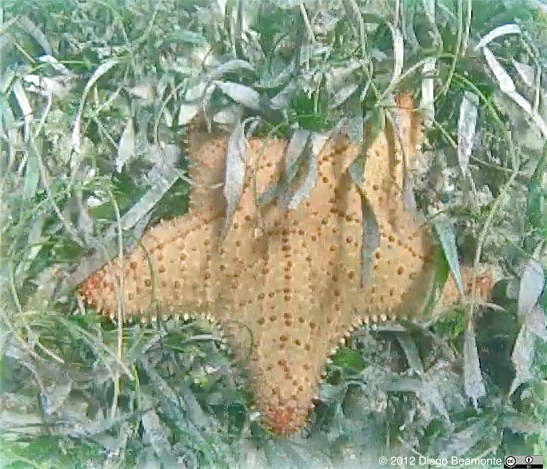
You can find this beautiful large equinoderms in the edge of the swimming area in Bill Baggs Cape Florida State Park, near the lighthouse
Colors range from bright red to orange to pale yellow. They are large, about the size of one extended hand.
Taking this picture (actually a frame from the short video below) cost me a bad cramp on my left leg.
The tide was high, and the strong current forced me to keep swimming at full speed just to stay still. While trying to do a final push to get a close up picture, my left leg got cramped, really bad. Seconds after I was drifting at about 4 knots away, and I had to star swimming to the shore with only one leg. If you can picture limping while swimming, that was me. It was painful but the fear of being drifted past the lighthouse point, into the open waters of Key Biscayne, was even worse. Doing a last effort, I reached with my hand to the sharp edges of the last rock in the point, and held there, hanging just from my hand while the rock cut my fingers, while the current pushed my body like a kite. After a couple of minutes, I could recover my breath, and finally made it safe to the shore, and my wife helped recover the cramped leg with her expert massage. A lesson about the strong tides in Bill Baggs Cape I wont forget easily!
I'll seek more of this beautiful animals, and will eventually replace this picture with a better one. There are plenty, but as they are in 5-10 feet (2-3 m) waters, light and water turbulence conditions are a challenge to get a good video or picture.
Update on 12/25 - I got a couple more pictures of beautiful cushion sea stars, as always, from the area in front of the Bill Bags lighthouse. The first one, more red in color, was beautiful, with heavily calcified spines on top.
The second one, yellowish, was huge, about a hand an a half (40 cm - 16 in) in size.
In this second one you can clearly see a paler circular structure, a bit off center - see enhanced picture below, and it is also visible in the red cushion star detail picture, above. This is the madreporite, basically a intake water control valve. You can find an excellent description, with schematic on how it works, and many more interesting details, in "The Echinoblog".
Not really yellow, but brown with lighter and darker spots. We have seen this amazing fish a few times, always in the same are of the Virginia beach in Key Biscayne. It usually lays down on sand, motionless, in what seems cryptic behavior. We have also seen this behavior when it lays on top of turtle grass.
When it feels threatened, it swims away very quickly. We capture this in the video, below. In most cases, it first tries to "hide" in the environment, then starts swimming as it notices our focus, and finally, it disappears in a fast swim.
On another occasion we captured two of them together. In the camera. They are sting rays, so you want to stay a bit apart from them.
According to the Marine Species identification portal, it could be 1.2 to 1.8 meter wide. The ones we have seen are much smaller than that. Wikipedia mentions 70 cm (28 in) long. All the specimens we have seen are more about a foot (30 cm). Probably juveniles, that close to the shore.
We are still trying to see if it changes color, like cuttlefish, or not. Wikipedia mentions they could change coloration in response to the environment, but we have not been able to see that in the videos. So far.
Family: Udoteaceae - tropical, calcified alga Class:Bryopsidophyceae - macroscopic green alga Conservation status: not yet assessed Sighting: Occasionally, in sandy areas between turtle grass beds. We have seen plenty of this beautiful alga in the sandy areas of Crandon park in Key Biscayne. It is a mesmerizing sighting, as they move in slow motion, back and forth, with the waves. Classifying this one has been a bit challenging. We are unclear if this is the Paddle blade alga (our best bet) or the fan alga. Pictures look similar, and there are some not very encouraging indications "Positive identification requires laboratory examination of the specimens." We settle for Paddle blade alga, based on pictures and geographic distribution if any reader can help provide a better identification, we will appreciate.
Family: Hydrocharitaceae - aquatic plants Class:Angiospermae - flowering plants Conservation status:Least concern, population stable Sighting: Very frequent, all over Biscayne Key
Turtle grass is the first thing you'll find when you snorkel in Key Biscayne. It is specially abundant in Bill Baggs Cape Park, starting a few feet from the shore. Also in Crandon park, as soon as the sand starts to get covered by green, that is mainly Turtle Grass. After a strong storm, you will also find large amounts of turtle grass leaves in the seashore, creating a brown dam, in same cases up to a couple feet high. As you can read in the links, turtle grass is actually a flowering plan, growing from a rhizome. The name comes form the Green turtle (Chelonia mydas), that feeds on the grass, although is a natural habitat for many animals, and feeds multiple herbivorous fishes of the florida waters, some of which eat the algae that grows in their leaves, rather than the seaweed itself. And of course, manatees graze turtle grass! Although it looks uneventful, almost boring, if you look carefully, you can discover a variety of creatures hiding in the beds of turtle grass. Starting with other seaweeds and algae, sponges, crabs, conchs, and many different solitary swimming fishes, like pufferfishes.
In the Crandon park area, turtle grass grows large, specially in the shallow waters on the left of the main beach, by the natural park protected areas.
The interface between the higher beds of turtle grass and the clear sand , like the one in the picture at the right, are also great areas to see all sorts of fish, hiding in the dark shadows created by the turtle grass. If you are patient and quiet, once your the shock for your presence is over, small and larger fishes will start swimming out of the shadows, making for a great beginner snorkeling experience.
Common Name:Blue Crab Scientific Name:Callinectes sapidus Family: Portunidae - swiming crabs Class:Malacostraca - Main crustacean class: lobsters, shrimps, crabs... Conservation status: Not listed Sighting: Frequent, in shallow, sandy waters.
- We have found several Blue Crabs, always alone. They are a fancy and lively sight, identified by the vividly distinctive blue colors of its legs. They quickly respond to our approach by switching into a rather enthusiastic defensive stance. They raise the front of their carapace, and snap their claws. Then, quickly, yet never letting down their guard, they scram sideways searching for a hiding spot among the seagrass, helped by the flapping of their seemingly ungraceful swimming legs.
This one was spotted buried in the sand, eyes sticking out like a periscope, and we almost stepped on it. Once his hiding place had been compromised, it swiftly raced to the seaweed bed on the border of the sand bank, where it stopped and spied on us. We captured this on video! After a while watching each other, it decided to seek refuge in the dense forest of turtle weeds, further from the dangers of the sand. Such as pelicans... and distracted humans.